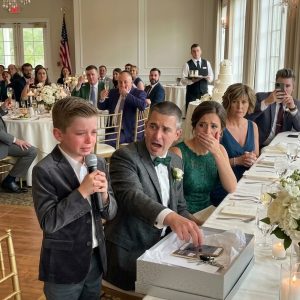
The vineyard stayed lit long after most of the guests had finished eating, as if Alder Ridge refused to acknowledge that anything outside its gates still mattered. Empty plates were cleared slowly, deliberately, like no one wanted to break the fragile spell that had formed over the evening. Conversations softened into smaller circles, then into quiet reflections, then into pauses that didn’t feel awkward so much as earned. People lingered at the tables not because they were waiting for something more, but because they were remembering what it felt like not to be evaluated. Grandma sat at the center of it all like a fixed point, occasionally reaching for her glass, occasionally correcting someone’s memory of an old family story with surgical accuracy.
I watched her more than I participated, because something about the night still felt unreal—like I had stepped into an alternate version of my own life where I had not been reduced to a supporting character in someone else’s narrative. My phone remained face down on the table, but I could feel it vibrating intermittently like a pulse I refused to check. Every vibration represented a different version of panic unfolding somewhere else.